Do you also struggle to sleep during tropical (>20ºC) and equatorial (>25ºC) nights?
We at Predicta do lose sleep over increasing temperatures (both literally and figuratively), so we’ve taken a look at the latest available data in our Regional State of the Climate Dashboard. These are related to summer 2026, so we’ll be exploring night temperature trends over that season in the course of the last few years.
Why focusing on night temperatures? Because data are showing an increase of daily temperatures, which generally results in its rise at night too. And the higher the temperature when bedtime comes, the higher the chances of not being able to sleep and rest properly. Our bodies need proper rest in order to self-regulate and a lack of this may result in diminished ability to concentrate and fatigue. Sleep deprivation is used as torture for a reason.
Between June 1 and August 31 (which is the period our tool considers “summer” for practical reasons), the Instituto de Salud Carlos III's Mortality Mornitoring tool attributed 5,123 excess deaths in Spain to heat, the most of them recorded during the moments heat waves were peaking. Taking into account the negative effects of excessive heat and lack of proper rest at night in the human body, we are venturing to find out what our latest Regional State of the Climate Dashboard data show regarding summer nights.
Hotter daytime, warmer nighttime
Let’s take Barcelona province, for instance. What happened in a densely populated region by the Mediterranean sea, which is warming faster than other oceans due to pollution generated by human activities? Its 32 days with record-breaking maximum temperatures over the span of summer translated into the highest-ever number of tropical nights since records began in 1940: a total of 41.42 nights above 20ºC as average temperture in the province. Let’s add some context here – data show the second summer with the highest number of tropical nights in the list was 2022, and recorded 32.34 >20ºC nights in the whole season, almost nine nights less than this year.
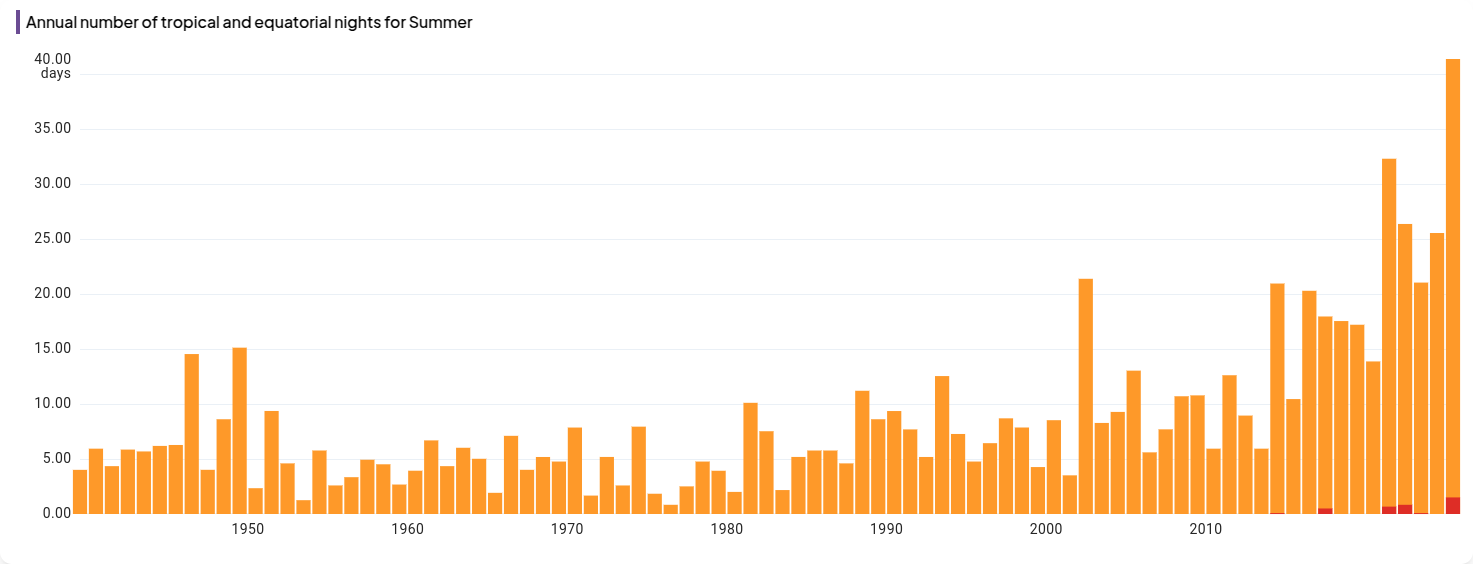
When it comes to equatorial nights (>25ºC) the picture is grim too. The average night temperature went over that threshold for the first time in 2015 (0.08 nights), and has quickly become a regular feat, with 2026 recording its highest ever (1.51 nights).
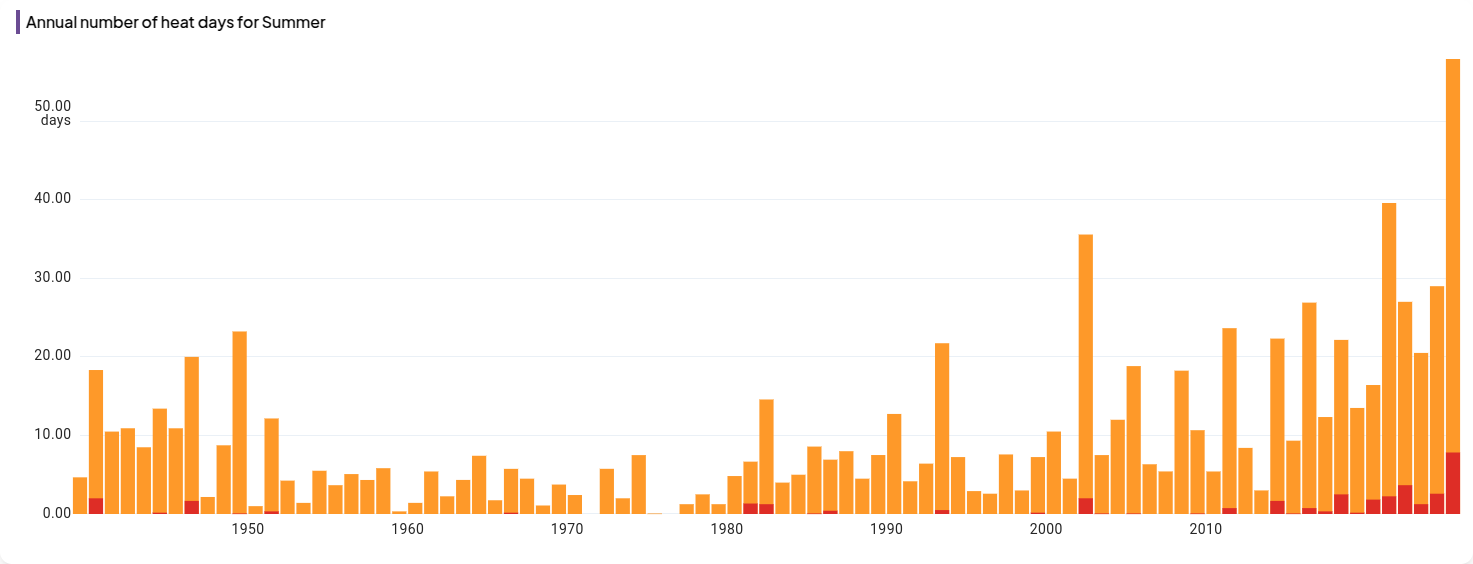
The tropical-and-equatorial-nights chart mirrors the over-30ºC-days one we’re showing below almost perfectly.
It may be worth mentioning our dashboard does not model urban heat islands, which may have resulted in higher nighttime values, pulling the regional trend shown in the figures upwards.
An Alpine challenge
What if we took a look at an inland mountain region going up North in the map? Would the trend be there too? Let’s see what happens in Savoie province, France, comprising several high-altitude Alpine mountains, with an average altitude above 1500 meters above sea level and surrounded by leg-breaking Tour de France summits.
The summary warns the area is warming in summer at a 0.37ºC-per-decade pace since 1940, which means 1.11ºC every 30 years. It’s a similar trend we’ve witnessed before in other locations in Europe, a continent warming at a faster pace than the rest of the world.
Meanwhile, in Savoie, the figure below shows the constant warming in that Alpine region, even though tropical nights are a matter of the current century.
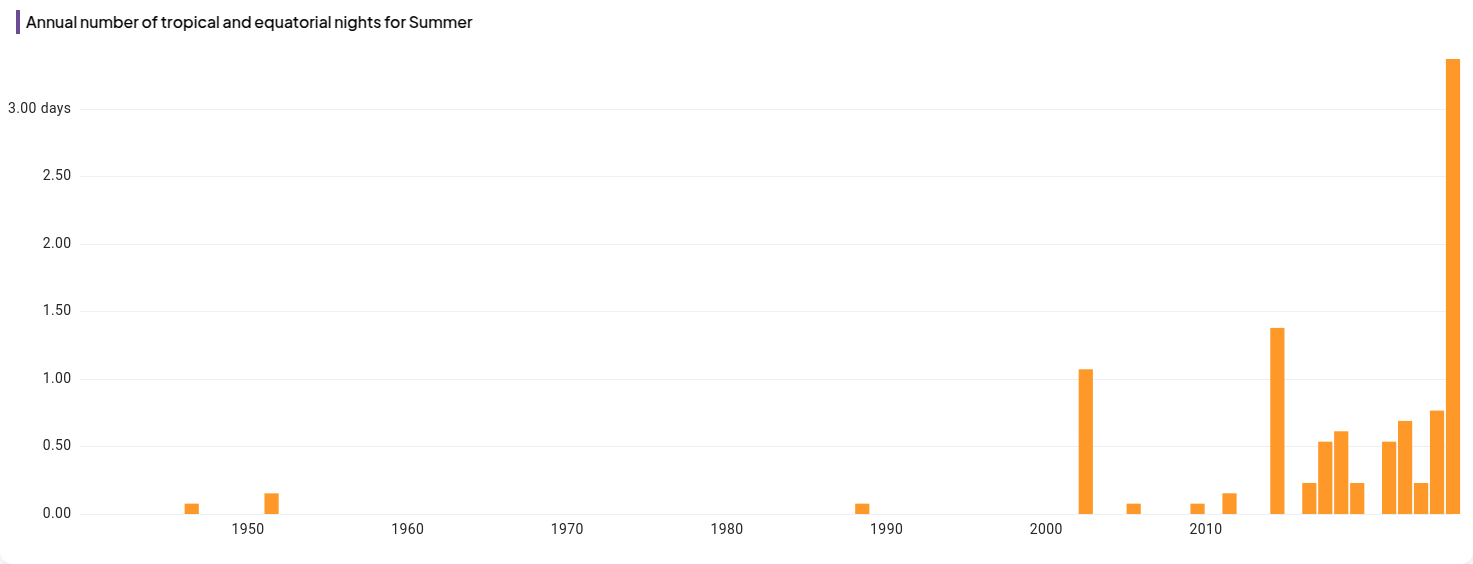
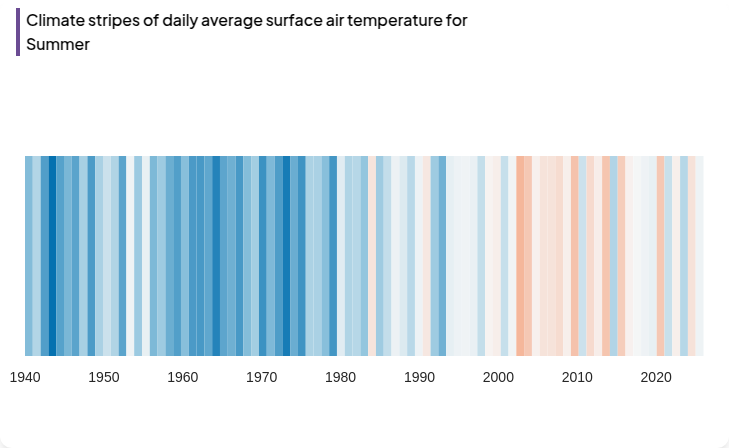
It is only in Northern European locations such as Iceland that no >30ºC days nor >20ºC nights have been ever recorded. However, the warming trend in daily temperature (and hence nighttime temperature too) is obvious and constant, as shown in graphs like the one below.
Have you found this interesting? As you already know, you can reach out to us here should you want to develop similar tools.
And given we mentioned the Instituto de Salud Carlos III at the beginning of the post, let us show you the
covid-tracking tool we developed for that institution.