
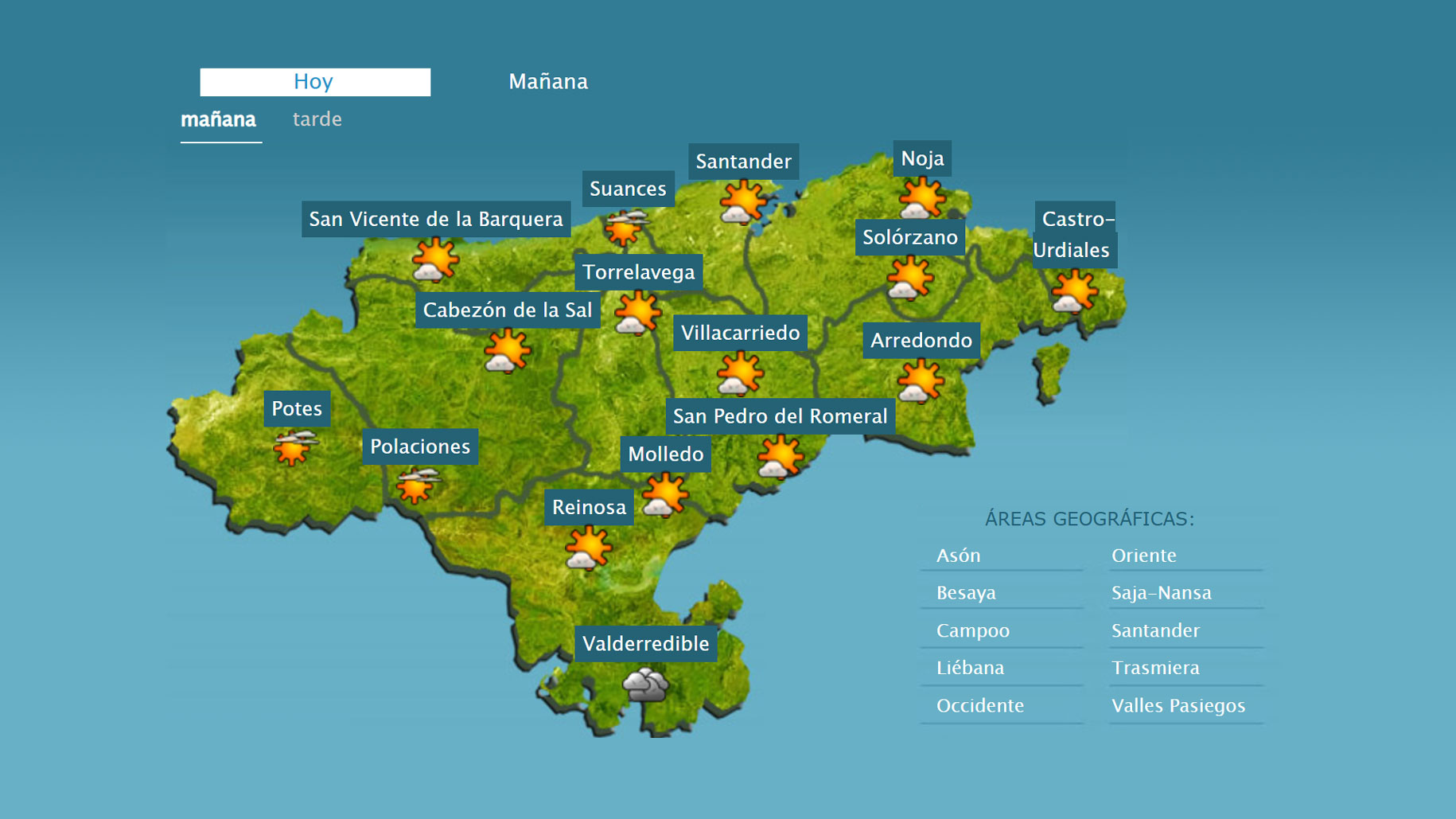
Description
Meteocantabria emerged as a joint initiative of the Department for Environment of the Regional Government of Cantabria and the National Meteorological Department. These agencies signed an agreement to promote the birth of MeteoCantabria as well as an inventory and integration of the Cantabrian meteorological and climatic information.
The website, developed by Predictia, integrates different sources of information.
AEMET provides information about:
- Weekly municipality forecast
- Regional level forecast
- Meteorological station observations
- Satellite and RADAR observations
- Numerical weather forecast using the HIRLAM model
- Maritime, mountain and coastal forecasts
- Lightning observations
- Ultraviolet radiation forecast and observations
Other info integrated in the site:
- Air quality observations provided by CIMA
- Forecasts for water temperature, salinity, and watercourse generated by IHC's OPROMS model
- Buoy and ports data
- Pollen information
Features
Due to the heterogeneity of the information to be represented, it was decided to develop two independent components: one is in charge of feeding the database (ETL component). The other one is accessible to the general public and displays the information. Both components are web applications fully implemented in Java with a layered architecture.
- The ETL component uses scheduler framework Quartz, which allows us to define a set of jobs, and schedule the time to be triggered. Also the Spring Framework is used to take care of IOC and also as database access support. A control panel for the jobs was implemented using the Struts2 Framework, implementing the MVC pattern.
- The web component also uses Spring as well Struts2 as its MVC framework.
References
The web site has been well received by the regional public and was featured in the press when it surpassed the half-million hits milestone and 100.000 users in its first year of operation.
